

소개
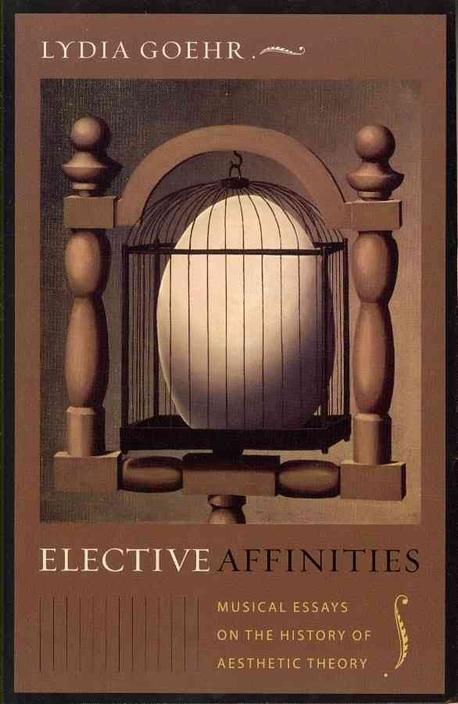
Lydia Goehr is professor of philosophy at Columbia University and the author of The Imaginary Museum of Musical Works. An Essay in the Philosophy of Music and The Quest for voice Music, Politics, and the Limits of Philosophy.With Daniel Herwitz, she is the editor of The Don Giovanni Moment. Essays on the Legacy of an Opera The author traces the elective affinites between philosophy and music, exploring such questions as what makes American opera American, when might film be described as visual music, under what conditions beauty and truth are found in the nightingale's song, and much more. Lydia Goehr is professor of philosophy at Columbia University and the author of The Imaginary Museum of Musical Works: An Essay in the Philosophy of Music and The Quest for Voice: Music, Politics, and the Limits of Philosophy. With Daniel Herwitz, she is the editor of The Don Giovanni Moment: Essays on the Legacy of an Opera. As illustrated in Goethe's famous novel of the same name, elective affinities are powerful relationships that crystallize under changing conditions. In this new book, Lydia Goehr focuses on the history of elective affinities between philosophy and music from German classicism, romanticism, and idealism to the modernist aesthetic theory of Theodor W. Adorno and Arthur C. Danto. Aesthetic theory, she argues, depends on a dynamic philosophy of history centered on tendencies, yearnings, needs, and potentialities. With this in mind, she recasts the theses of Adorno and Danto regarding the death or end of philosophy, art, music, and human experience as arguments for continuation and survival. Elective Affinitiestracks the migration of aesthetic and critical theory from Germany to the United States following the catastrophic period of the twentieth century marked by the Second World War. Elective Affinities brings the often very different (and oppositional) philosophy of the aesthetics of Danto and Adorno into a richly informative exchange, making good the case that whatever their considerable differences, there are important points of convergence, such that what emerges is greater than the sum of the parts. Elective Affinities is a great book. Lydia Goehr demonstrates that critical theory is not as dead or philosophically doctrinaire and petrified as many would like to believe. Instead, her study is a brilliant and persuasive intervention arguing for the significance of critical theory today, supplying the evidence that critical theory still plays a crucial role in the project of philosophy-Continental or not. [Goehr's] analysis is erudite, lucid, and always suggestive.... [ Elective Affinities is] genuinely magnificent and lastingly influential. "her analysis is erudite, lucid, and always suggestive...[Elective Affinities is] genuinely magnificent and lastingly influential." -- History and Theory This book on the elective affinities of music to philosophy and drama, to birdsong and violence, to film and nationhood is imaginatively textured around two resonating themes: the persistent battle of philosophical aesthetics with history and the arts and the unusual confrontation of a European and an American aesthetic of the modern. Thinking with and through the work of Theodor Adorno and Arthur Danto, Lydia Goehr gives us a series of brilliant musical essays linked by the sustained focus on the movement of concepts such as musicality, art's relation to nature and the commonplace, the experimental, the monumental, film as visual music, and music in film. A common thread, drawn into a pattern in the final chapter, is the elective affinity between European (especially German) and American aesthetic theory and practice. As illustrated in Goethe's famous novel of the same name, elective affinities are powerful relationships that crystallize under changing conditions. Lydia Goehr focuses on the history of elective affinities between philosophy and music from German classicism, romanticism, and idealism to the modernist aesthetic theory of Theodor W. Adorno and Arthur C. Danto. Aesthetic theory, she argues, depends on a dynamic philosophy of history centered on tendencies, yearnings, needs, and potentialities. With this in mind, she recasts the theses of Adorno and Danto regarding the death or end of philosophy, art, music, and human experience as arguments for continuation and survival. Elective Affinities tracks the migration of aesthetic and critical theory from Germany to the United States following the catastrophic period of the twentieth century marked by the Second World War. " Elective Affinitiesis a great book. Lydia Goehr demonstrates that critical theory is not as dead or philosophically doctrinaire and petrified as many would like to believe. Instead, her study is a brilliant and persuasive intervention arguing for the significance of critical theory today, supplying the evidence that critical theory still plays a crucial role in the project of philosophy& -Continental or not." -- Willi Goetschel, professor of German and philosophy, University of Toronto