소개
David Ropeik is the director of risk communication at the Harvard Center for Risk Analysis. He was an award-winning journalist for two decades. George Gray, Ph.D., a toxicologist, has served as acting director of the Harvard Center for Risk Analysis.
David Ropeik is the director of risk communications at the Harvard Center for Risk Analysis. A regular commentator on NPR, he has written for the Boston Globe and worked as a television journalist for twenty-two years. He lives in Concord, Massachusetts.
George Gray, a toxicologist, serves as the Assistant Administrator for the Office of Research and Development at the U.S. Environmental Protection Agency. He lives in McLean, Virginia.
INTRODUCTION "I've developed a new philosophy . . . I only dread one day at a time." - Charlie Brown We live in a dangerous world. Yet it is also a world far safer in many ways than it has ever been. Life expectancy is up. Infant mortality is down. Diseases that only recently were mass killers have been all but eradicated. Advances in public health, medicine, environmental regulation, food safety, and worker protection have dramatically reduced many of the major risks we faced just a few decades ago. Yet new risks have arisen. Hazardous waste. Nuclear power. Genetically modified foods. Mad cow disease. Ozone depletion. Artificial sweeteners. For all the unquestionable benefits of the modern technological world and its scientific power, the march of progress that has given us longer, healthier lives has subjected us to new perils. We often react to this conflict, of progress on the one hand and risk on the other, with fear. Most of us are more afraid than we have ever been. And not just from any single risk that happens to be grabbing the headlines at a given point in time, whether it's terrorism or West Nile virus. We are afraid, cumulatively, of all the new bogeymen to which our modern existence has exposed us. Many polls find that people feel the world today is more dangerous for humans than it has ever been. It is true that the industrial and information ages have spawned a whole new range of risks, and raised awareness of those that were lurking all the time. But research suggests that our fears may not match the facts. We may be too afraid of lesser risks and not concerned enough about bigger ones. Polls show a wide gap between what the public and the "experts" think is actually dangerous and what is considered relatively safe. Who's right? There are no simple answers. But information can help us begin to sort things out. Some basic facts about the risks we face, or think we face, can help us make more sense of just what we need to worry about. The intent of this book is to provide that information. We want to empower you to make better judgments about how to protect yourself and your family and friends. Our goal is to help you put the risks you face into perspective. Risk issues are often emotional. They are contentious. Disagreement is often deep and fierce. This is not surprising, given that how we perceive and respond to risk is, at its core, about nothing less than survival. The perception of and response to danger is a powerful and fundamental driver of human behavior, thought, and emotion. In writing this book, we tried to stay as neutral about these controversial issues as we could. We think that information devoid of advocacy is a tough commodity to come by these days, and will be more useful to you. We do not tell you what you should think. Nor do we make judgments about whether a risk is big or small for you as an individual. We offer numbers for society as a whole, but there is no overarching single conclusion about any risk that can be drawn for each reader. Each of you has unique circumstances that make any given risk higher or lower for you than it might be for the next person. Ultimately, how you perceive a given risk is a decision for you to make in the context of your own life. We simply hope that you are more able to make more informed choices after reading the information we present. As Arthur Conan Doyle wrote in The Hound of the Baskervilles, "That which is clearly known hath less terror than that which is but hinted at and guessed." We have gathered and analyzed the basic information available on major risk issues and synthesized from all that research a fair presentation that you can use to make up your mind about the risks we exa
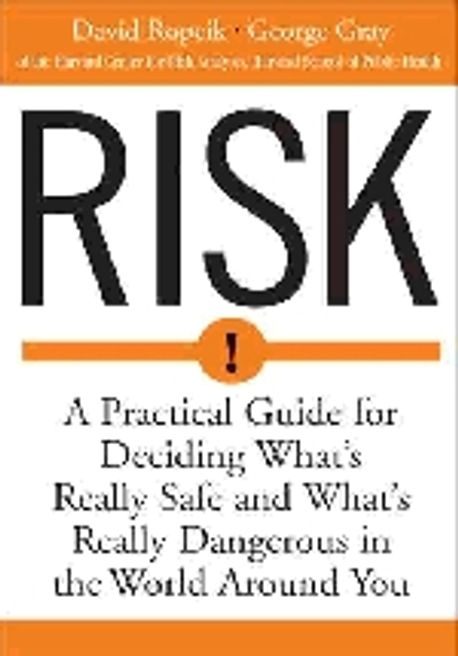
An indispensable and timely guide, Risk is the authority for assessing threats to your health and safety. We continually face new risks in our world. This essential family reference will help you understand worrisome risks so you can decide how to stay safe and how to keeps risks in perspective. Expert authors David Ropeik and George Gray include information on: - 50 top hazards - your likelihood of exposure - the consequences - ways to reduce your risk They cover topics such as: - cancer - biological weapons - indoor air pollution - pesticides - radiation
An indispensable and timely guide, Risk is the authority for assessing threats to your health and safety. We continually face new risks in our world. This essential family reference will help you understand worrisome risks so you can decide how to stay safe and how to keeps risks in perspective. Expert authors David Ropeik and George Gray include information on: - 50 top hazards - your likelihood of exposure - the consequences - ways to reduce your risk They cover topics such as: - cancer - biological weapons - indoor air pollution - pesticides - radiation
"An endlessly fascinating reference book, to be consulted occasionally in time of need and in time of curiosity."
"Explores the hazards of of everyday activites at home, work and elsewhere..."
"Explores the hazards of of everyday activites at home, work and elsewhere..." The New York Daily News "An endlessly fascinating reference book, to be consulted occasionally in time of need and in time of curiosity." The Denver Post
CONTENTS Introduction 1 PART I . HOME, TRANSPORTATION, WORK 1. Accidents 23 2. Air Bags 34 3. Alcohol 39 4. Arti'cial Sweeteners 48 5. Bad Backs, Carpal Tunnel Syndrome, and Other Repetitive Task Injuries 53 6. Caffeine 64 7. Cellular Telephones and Driving 70 8. Cellular Telephones and Radiation 76 9. Electrical and Magnetic Fields 81 10. Firearms 87 11. Foodborne Illness 97 12. Food Irradiation 104 13. Genetically Modi'ed Food 109 14. Mad Cow Disease 117 15. Microwave Ovens 121 16. Motor Vehicles 125 17. School Buses 135 18. Tobacco 139 PART I I . THE ENVIRONMENT 19. Air Pollution (Indoor) 151 20. Air Pollution (Outdoor) 166 21. Asbestos 180 22. BiologicalWeapons 186 23. Carbon Monoxide 195 24. DDT 202 25. Diesel Emissions 207 26. Environmental Hormones 212 27. HazardousWaste 223 28. Incinerators 232 29. Lead 241 30. Mercury 247 31. Nuclear Power 254 32. Ozone Depletion 264 33. Pesticides 270 34. Radiation 283 35. Radon 294 36. Solar Radiation 299 37.Water Pollution 308 PART I I I . MEDICINE 38. Antibiotic Resistance 321 39. Breast Implants 329 40. Cancer 336 41. Heart Disease 348 42. Human Immunode'ciency Virus 363 43. Mammography 369 44. Medical Errors 376 45. Overweight and Obesity 384 46. Sexually Transmitted Disease 392 47. Vaccines 401 48. X Rays 410 Appendix 1: Various Annual and Lifetime Risks 421 Appendix 2: The Risk Meters 429 Acknowledgments 443 Notes 445 Index 459