소개
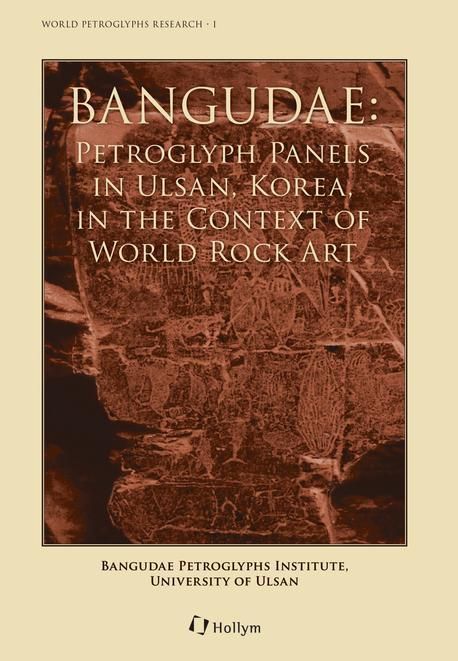
Comprehensive and organized research on the Banguade Petroglyphs in English edition!
Several decades ago, the Banguade Petroglyphs and the Cheonjeon-ri Petroglyphs were discovered along the Daegok Stream in Korea. This discovery sparked the research of petroglyphs in Korea, and so far, twenty-eight petroglyph sites have been located. Still, however, the Bangudae and Cheonjeon-ri sites are the only sites designated and protected as National Treasures. The two sites are special as they contain a variety of images engraved over a long period of time on large rock surfaces.
Unlike the Cheonjeon-ri Petroglyphs, the Bangudae Petroglyphs of Daegok-ri are submerged under water for seven or eight months of the year. It is because the water level rises higher than the rock surface where the petroglyphs were engraved due to the construction of the Sayeon Dam, built ten years before the petroglyphs were discovered. Sadly, the debate over preventive steps against damage only started ten years ago, without a suitable solution as of yet.
Since its discovery, the Bangudae Petroglyphs have drawn huge attention from in and outside Korea. The numerous figures of animals, especially marine animals depicted across extraordinarily large rock surface are unique. Most notably, realistically rendered images of whales are not found in other Korean petroglyphs. For this reason, researches of this site have focused on whale images and their socio-historical meanings.
On the other hand, full-scale field survey of the site had not been conducted for thirty years before the University of Ulsan Museum published a detailed survey report in 2000. One of the contributions of the report is that it assignes serial numbers to all the identifiable figures of the Bangudae site in order to facilitate further research.
Among major international researchers of rock arts, the Bangudae site is well-recognized for its scale, unique contents of its petroglyphs, and their pictorial composition. Its significance is enough to qualify it as a candidate for a World Heritage site. In the field of studies of world prehistoric art, however, the need to clarify the significance and meaning of the Bangudae Petroglyphs in the context of the prehistoric culture of East Asia has not been fully acknowledged. This is because detailed information on the Bangudae Petroglyphs and their cultural context have not been available to foreign scholars.
With the awareness of these various needs, the Bangudae Petroglyphs Institute of University of Ulsan and the Korea Studies Institute of Harvard University co-hosted “The First International Symposium on Petroglyphs” on April 26 and 27, 2012. In the symposium, held in Cambirdge, U.S., renowned international researchers of petroglyphs presented papers on the Bangudae petroglyphs and related subjects. The presenters and discussants all acknowledged the significance of opening the international discussion of this important site of East Asian history and prehistoric art. The book is based on the papers presented during the symposium.
반구대암각화에 대한 종합적이고 체계적인 연구를 담은 영문 단행본
『Bangudae: Petroglyph Panels in Ulsan, Korea, in the Context of World Rock Art (세계 바위예술의 흐름 안에서 본 반구대암각화)』는 지난 2012년 4월 미국 보스턴에서 울산대학교 반구대암각화유적보존연구소와 하버드대학교 한국학연구소가 공동 개최한 “제 1회 암각화 국제심포지엄”의 결과물로, 국내외 암각화 전문 연구자 및 세계 문화유산 보존정책 전문가 7인의 논문으로 이루어져 있다. 이 책의 가장 큰 특징은 반구대암각화를 아시아 및 세계 선사문화의 맥락에서 다루며, 이를 해외 암각화연구의 방법론과 틀 안에서 재조명하고 있다는 점이다. 이는 반구대암각화를 해외 암각화와의 비교 속에서 도상학적, 구조적으로 분석한 최초의 연구라는 학술적 의의를 가지고 있다. 또한 국내외 암각화 유적 현황과 상세한 도면, 사진자료를 통하여 보다 폭넓은 이해를 돕고 있다.